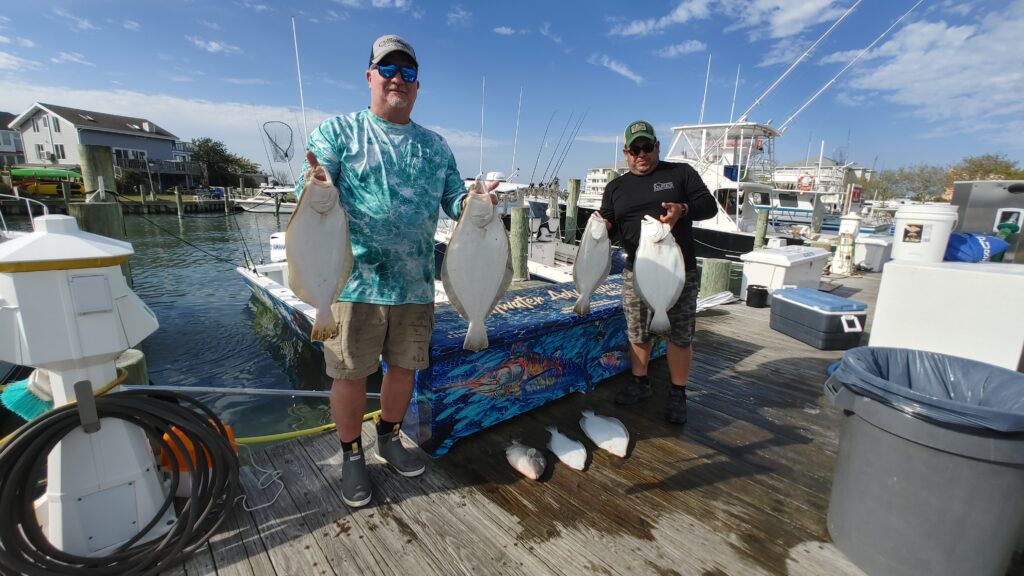
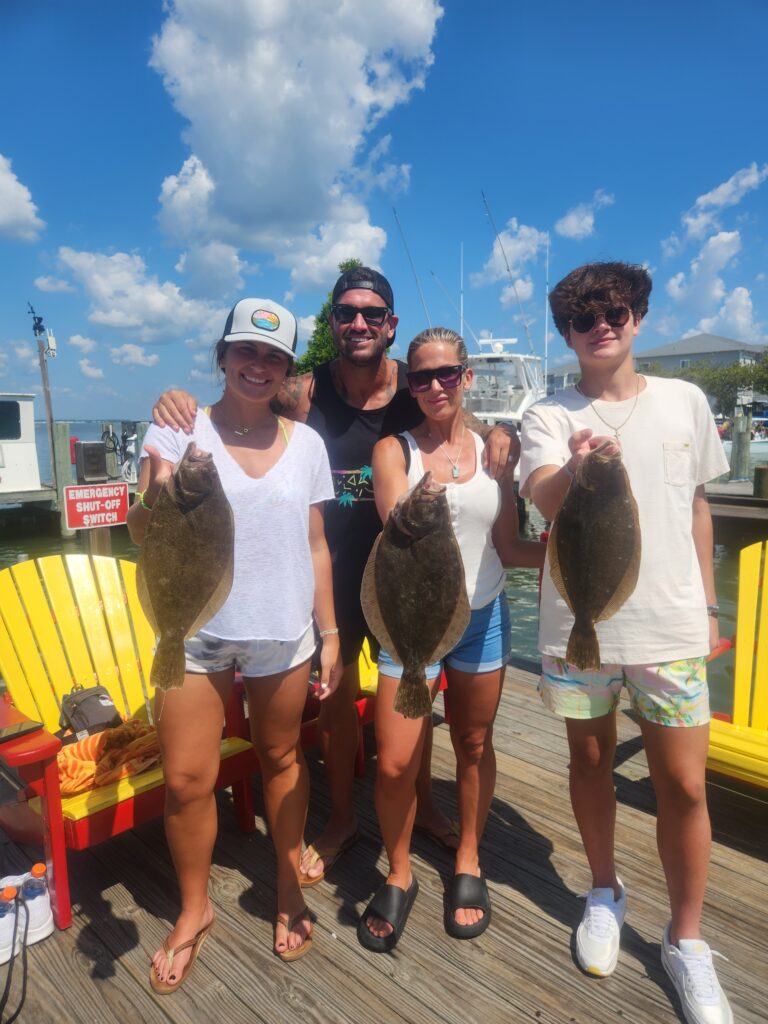
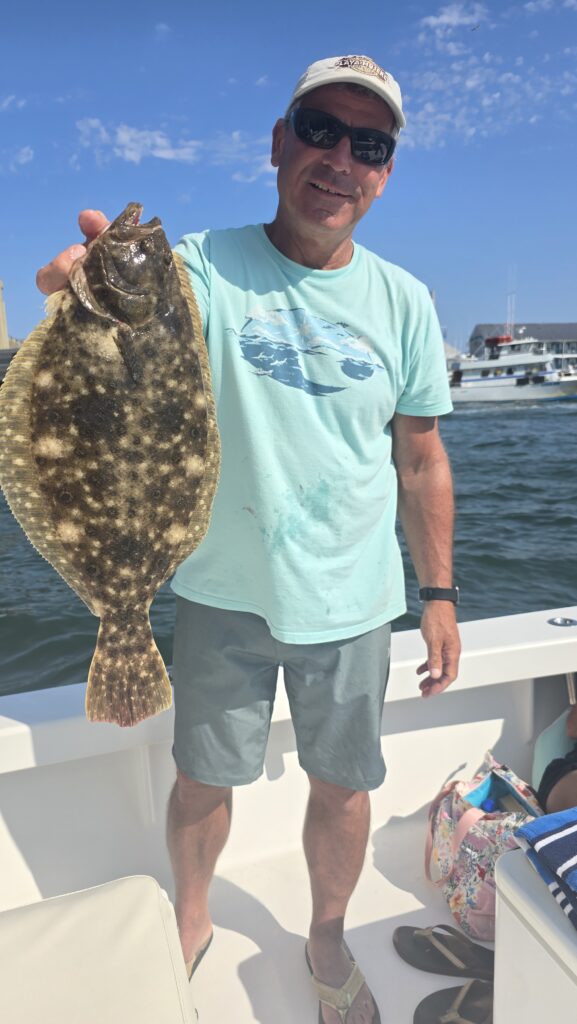
Understanding the Flounder Bite
In my opinion, being able to detect a flounder “bite” is the most important part of the equation. I like to describe it as a very distinct “thud”. Once you can consistently detect this “thud”, you’re well on your way to becoming a good flounder fisherman. It’s not that difficult and most people can pick it up rather quickly. As I said earlier, your bait must be on or near the bottom.
What a Flounder Bite Feels Like
When I have a first-time flounder fisherman on board, I always start them out with some type of chicken rig (a high/low setup) on the end of their line. If we’re drifting in the back bay, it will almost always be tandem jig heads with a 4-inch Gulp swimming mullet and a live minnow on each. Flounder belly or squid will also work in place of the live minnows.
If we’re drifting in deeper water (35-100 feet) out on the ocean, I’ll also use a chicken rig with either a 3 or 4-ounce sinker on the bottom. I make all my own rigs and this past season I started using a product called “Rig Mate” (www.rigmate.com). They are pre-tied dropper loops that come on a spool. A great product that is very convenient to use and saves a good amount of time.
Teaching Beginners to Detect Bites
When charter fishing, I’m always racing against the clock. Trips range from 2-6 hours. As a captain, your goal is to bend rods and put fish in the box. If you can’t do that consistently, you won’t be in business very long. In this day of online reviews, you live and die by this sword. On some of these shorter trips, it can be difficult sometimes due to the time constraint. This is why it’s very important for captains and mates to be good teachers. It doesn’t matter what species you’re targeting. If they’re new to this type of fishing, you must be able to give them a “crash course” on the techniques needed to catch this species.
Targeting bottom species like Sea Bass, Triggerfish, Scup, and Tilefish are straightforward. Bait the hook, drop it down, get the bite, set the hook and reel it in. For most anglers, it’s a natural response to set the hook as soon as they feel something. This is especially true for freshwater fishermen. Flounders can be a bit more difficult, and you must break this habit of setting the hook immediately.
You must give the flounder time to eat the bait, especially on bigger fish when using bigger bait.
So how do I get a beginner up to speed in a short time? I try to get them to visualize what’s going on down there on the bottom. My goal is for them to be able to distinguish the difference between an actual flounder bite and their rig just bumping something on the bottom. This something could be shells, rocks, or coral. It could be part of an artificial reef or an actual shipwreck. This is where you’ll find the flounders hiding in ambush. You will get snagged from time to time. There’s a saying: “if you’re not getting snagged, you’re not flounder fishing in the right spot”.
It’s very important to visualize your sinker or bucktail dragging over the bottom bumping these things. Once you can understand and “feel” the difference, you’ll know when your targeted species just picked up your bait.
My Teaching Method
First, I start beginners off fishing the rods from the rod holders for the first couple of drifts. I want them to see how the rod tip responds to the rough bottom. Hopefully we get an actual bite within a drift or two and they can see the difference in the tip. Once this happens, I have them pick the rods up. Next it’s important for them to feel the sensation of their rig bumping into something other than a fish. Once they understand what it feels like, this will help them break the habit of setting the hook on every bump.
The next step is to teach them how to add a little action into their bait. This is where I introduce a “jigging” motion and it’s done with the rod tip. Some people fish with their rod tips up at a 45-degree angle and make little twitches up. I like keeping my rod tip pointed down towards the water. I don’t like any slack in my line, and I feel this works better for me. I always want to have contact with the bait. Both ways are fine, just try to always keep your bait within 6-12 inches of the bottom.
Your First Flounder Bite: What to Do
Most likely, you’re drifting along between a half and two and a half knots. Whether in the back bay or over some type of structure in the ocean, it really doesn’t matter. Whatever speed your boat is moving, your bait is moving at the same speed. The flounder being stationary is doing one thing. They’re hiding and waiting for their next meal to swim by. If your presentation is close enough, they’ll explode up and grab it.
If your bait passes by in their field of vision, they’ll swim after it. Flounders are fast swimmers. While fishing for stripers, I’ve caught multiple flounders while trolling at 2.8 – 3.2 knots. I caught these fish on diving plugs, “Stretch 25’s” fishing in 25-30 feet of water.
There are quite a few online videos showing flounders chasing baits underwater. It’s amazing how far they’ll follow a bait sometimes.
Either way, when you feel that thud, you must stop the forward motion of your bait for 3-5 seconds. Some will describe it as “letting the line out for 3-5 seconds”. I think it’s easier to understand the “stopping” theory and here’s why. I’m assuming a flounder laying on the bottom does the following: The prey swims by and the flounder launches off the bottom to grab it. In real life, I don’t believe there’s very much resistance when a flounder strikes its prey. I don’t think the prey drags the flounder another 4-6 feet. So, I believe stopping the forward motion of your bait at the strike is a more natural presentation for a flounder.
I use both spinning and conventional reels but prefer spinning reels in deeper water. Either one, the line must be able to come off the reel freely. I always fish with my bail open and my finger holding the line against the rod above the reel. This helps to detect the slightest bites. For me, this is easier to accomplish using a spinning rod.
Once you stop your bait and wait 3-5 seconds, the next move is to engage the reel. Lightly lift the rod tip up to see if there’s any resistance or weight. If there is, continue lifting the rod tip up in one steady motion. You want to use just enough force to set the hook, but not too much that will yank the bait out of its mouth. You’ll get the hang of this in time. It will become second nature with more time on the water. Even though you do everything right at the bite, they’ll still come unglued sometimes. No big deal if you understand the following.
When You Miss: Getting a Second Chance
Here’s the scenario. You engage the reel and feel the resistance. You lift the rod tip, set the hook and start to reel. Your rod tip is bent over, and you feel like you have a good fish on. A few seconds into the fight, the fish is gone. You sigh and the disappointment sets in. Do not let this happen to you — be disappointed later.
The moment you realize that fish is gone, you must get your bait back down to the bottom. More than likely, that fish will still be interested, because their dinner just got away. When I “swing and miss”, I go right into free spool. Once it reaches the bottom, I jig it with a little more intensity trying to imitate wounded prey. You’ll be surprised how many times they come back, and you get a second shot.
There’s one exception and that’s when you’re using live bait. If you “pull the trigger and miss”, you’ll have to “reel in and reload”. The bait will be gone or dead.
Here’s another thought on how much time to allow before engaging the reel when using live bait. I heard this many years ago. I can’t say whether this is correct or not, but it does make sense. Ever watch a bird eat a fish? They must turn the fish around so they can swallow it headfirst. If not, the bird could choke on the fish due to the way the scales lay. I was told that this is the same for most species of fish. That’s why I always allow a little extra time when using a big live bait.
Just thought this would be worth sharing.


 Inshore Bay Fishing Charters Ocean City MD | Saltwater Adventures
 Nearshore Fishing Charters Ocean City MD | Saltwater Adventures
 Offshore Fishing Charters in Ocean City, Maryland | Saltwater Adventures